

 Reel 1 · June 1978
Forty Years of Film Reels in the Basement, and the Projector That Quit First
A retired television repairman finds his 1978 wedding on eight reels he can't play, and a neighbor who ran the school projectors hands him a cardboard kit. The box, the wait and the price, read line by line.
On the last Saturday of April, I stood at the bottom of my basement stairs with a flashlight in one hand and a cardboard box under my arm, trying to remember what was in it.

The box said WEDDING in my wife's handwriting, in green marker that had faded to the color of weak tea.
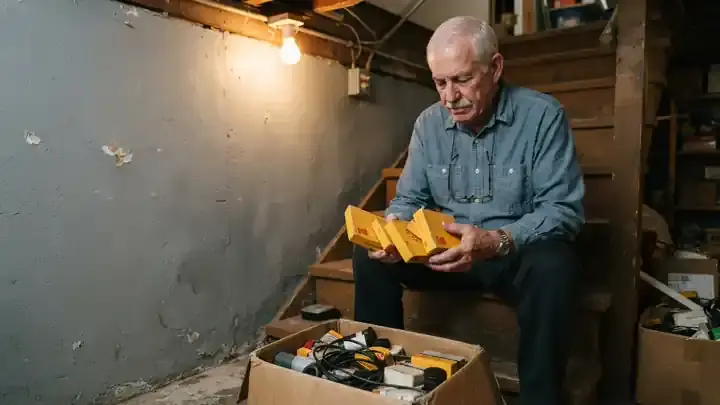
Inside were eight little yellow boxes, and inside each one was a reel of film I hadn't seen move since 1999.
I'm seventy-two. I repaired television sets and radios in Rockford, Illinois, for thirty-one years, and I have never in my life met a machine I couldn't at least open with a screwdriver.
But I could not, standing on that cold concrete floor, tell you the name of the song we danced to on June 24, 1978.
Marlene had asked me that morning, over coffee, and I'd said "give me a minute," and the minute had turned into the whole day.
So this is a column about a box in a basement.
It's about eight reels of film, a projector that quit before the memory did, and a neighbor named Arlo who knew exactly what to do with both.
It's also about a plain cardboard kit that crossed the country and came back with our wedding inside it.
If you've got a box like mine under your own stairs, you'll know most of this already.
Thirty-One Years of Other People's Pictures
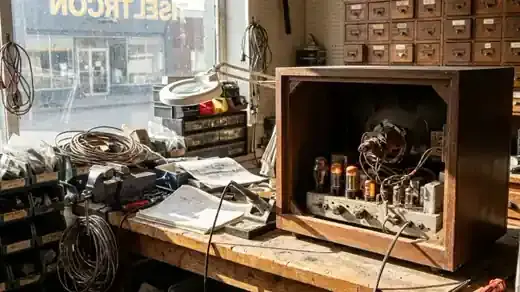
I opened Halvorsen TV & Radio on North Main in 1983, in a storefront that used to be a shoe repair.
It had a bell over the door and a workbench that ran the whole length of the back wall.
For three decades, people carried their pictures in to me. Not photographs, but the picture on the screen:
the one that rolled, the one that went green, the one that shrank to a white dot and disappeared.
I learned one lesson at that bench above all the others.
A picture that's fading doesn't fail all at once; it drifts a little every month until the day somebody finally notices.
By the time a customer brought a set in, it had usually been drifting for a year.
The colors had gone a shade warm, the edges had started to bow, and the family had simply gotten used to it.
I made a living catching those drifts.
I was the fellow who'd turn the set around, look at the tubes and say, gently, that it could be saved if they hadn't waited much longer.
Here is the part I'm a little embarrassed to admit. My own basement had been drifting for twenty-five years, and I'd been filing the evidence under "someday."
The first entry was the projector. It was a silver home-movie projector my brother-in-law Dick bought in 1976, and it lived on the second shelf by the furnace, under a dish towel.
In the fall of 1999, at our daughter Kristin's twentieth birthday, the drive belt snapped halfway through a reel of her first steps.
The room smelled like a hot iron, and the picture froze on her diaper and went brown.
I said I'd get a belt. I meant it, and I had the tools, and I'd been ordering belts for other people's machines since Carter was president.
I never got the belt. The projector went back under its dish towel, and the dish towel stayed there for twenty-six years.
What Forty Years Looks Like When You Count the Boxes
When I finally pulled every box off those shelves in April, I did what a repairman does with a set that's been sitting. I made a list before I touched anything.
The list was longer than I expected.
Eight reels of the wedding, fourteen reels of birthdays and Christmases, six reels of a 1984 trip to Lake Geneva, and three reels labeled only "Mom."
There were also two VHS tapes from the 1990s, a shoebox of slides from my Army years, and a cassette my father recorded of himself singing in the car.
That last one I didn't even know we had.
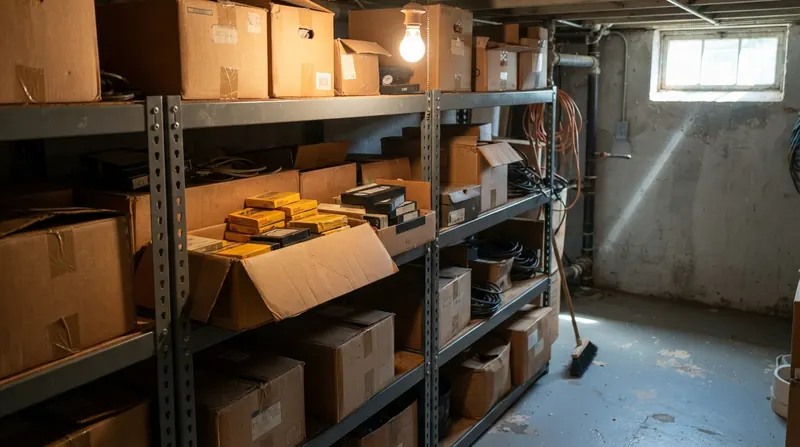
The yellow boxes were the ones that stopped me.
Dick had filmed everything in Super 8, the home-movie film everybody's uncle carried in the seventies, and the little cartridges came back from the lab on gray reels in yellow cardboard sleeves.
Each reel is about the size of a saucer. You could fit our entire married life, as filmed by Dick, into a single grocery bag.
I sat down on the bottom step with the "Mom" reels in my lap.
My mother died in 1991, and I realized, sitting there, that I could not picture the way she walked.
I could picture her face from photographs. I could hear her voice on the telephone if I tried hard enough.
But how she crossed a room, whether she swung her arms, whether she shuffled in her slippers, had slipped out of my head like a name at a party.
Somewhere on those three reels, she was walking. I knew that the way you know a set has a picture in it before you plug it in.
The Small Things a Head Drops After Seventy
I want to be plain about what had been happening to me, because I suspect many of you have the same list. Nothing loud, nothing that sent me anywhere with a siren.
The name of the neighbor of thirty years.
Our next-door neighbor on Ashland Avenue, a lovely woman who brought us tomatoes every August from 1987 on, and one morning in March I waved and could not, for the life of me, produce her name.
It was Dolores. It came back to me at four that afternoon while I was washing a pan, the way they always do, after the moment had passed.
The keys that moved.
I've hung my keys on the same brass hook by the back door since 1980, and twice this spring I found them in the refrigerator, once next to the butter.
The list I forgot at the store.
Marlene writes a list and I take it to the Schnucks on East State Street, and I came home in February with everything but the reason I'd gone, which was coffee.
And the word on the tip of the tongue.
The song from our wedding was the worst one, because Marlene asked and waited, and I watched her face go a little sad while she waited.
I'm not telling you any of that so you'll worry about me.
My clinician and I have talked about all of it at my checkups, and she's the person who keeps track of my head, not a newspaper column.
I'm telling you because it explains why that basement box suddenly mattered. A head after seventy drops small things, and you start to want the big things somewhere you can't drop them.
The wedding was on those reels. My mother walking was on those reels.
And the only machine that could show them to me was under a dish towel with a broken belt.
Mom says you were in the basement all day. Everything okay down there?
8:02Found the wedding reels, all eight of them. And three of Grandma Halvorsen.
8:05The wedding? I have never once seen that wedding.
8:06Neither has your mother since 1999. Working on it.
8:09What I Spent Before Arlo Walked Over
I want to be honest about the month I spent trying to do it all myself, because it's the part these stories usually skip.
A story that only lists what worked is an advertisement in a cardigan.
So here's the inventory, with prices, the way I'd have written up a repair that went sideways.
Item one: a replacement drive belt, $14.50 with shipping. It arrived in a padded envelope from a fellow in Ohio, and it was the right size, and it was not the problem.
The motor turned and the belt turned, but the take-up reel wouldn't catch. I spent two evenings on it with my good screwdrivers and Marlene bringing me coffee down the stairs.
Item two: a used projector from an online auction, $85 plus $22 shipping.
The listing said "works great," which in my trade is the phrase that means it worked once, for someone, in 2009.
It ran.
It also chewed the first eighteen inches of the reel labeled "Lake Geneva 3," the white leader at the front, and I stopped it before it got to anything that mattered.
I sat in the basement for a long time after that.
A repairman knows when he's about to ruin the only copy of something.
Item three: a bedsheet and four thumbtacks. That was the screen.
It cost nothing, and it's the only item on this list I'd buy again.
Item four: a small gadget from an electronics store, $179.
It was a box you were supposed to feed the film through to make a computer file, and it came with a booklet in very small type.
I'm good with machines. I could not make that one produce a picture that didn't flicker like a broken fluorescent tube, and I took it back within the week.
Item five, the expensive one, cost no money at all: I stopped going to the Tuesday coffee at the Legion.
I didn't want to sit at that table and fail to find a name in front of six men I've known for forty years.
That was the worst entry in the whole ledger. When you skip the people to avoid the moment, your world gets smaller one Tuesday at a time.
Add it up and I'd spent about $300 in a month, returned $179 of it, and missed four Tuesdays I'll never get back.
I tell you the number because I suspect many of you have a number of your own.
What a Projectionist Brings When You Stop Coming
Arlo Brandt is seventy-eight and lives two houses down, on the corner. He taught industrial arts at the high school for thirty-one years and ran the audio-visual room the whole time:
every projector, every screen, every film strip that ever rolled in that building.
He noticed my empty chair at the Legion before I'd admitted to anybody why it was empty. On the fourth Tuesday, he didn't call; he walked over with a thermos.
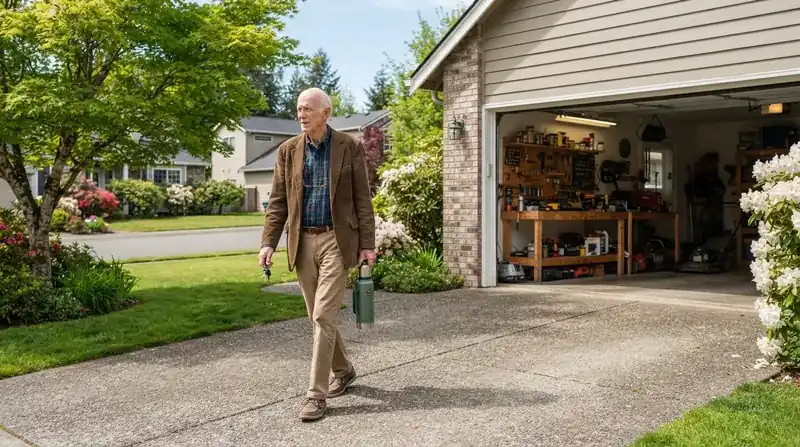
He came down the basement stairs without being asked, the way teachers do, and looked at the two projectors, the chewed leader and the bedsheet on the wall.
"Gene," he said. "You're trying to repair your way to your wedding.
That's like trying to drive to Chicago backward."
I told him what I'd told everybody. It's nothing, Arlo, I've just got a bad belt and a slow week.
He looked at me the way he must have looked at a sophomore who swore the band saw started itself.
Then he said it slowly, as if he were reading off a work order:
"The belt explains the projector; it doesn't explain why you stopped coming on Tuesdays."
That sentence sat in my basement for a long time after he went back up the stairs.
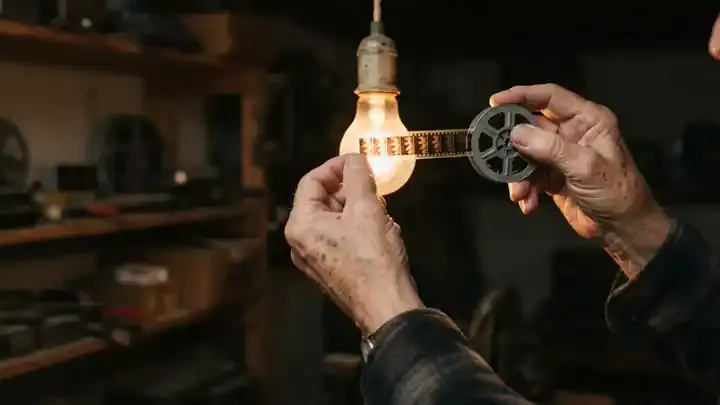
Before he left, he picked up the "Lake Geneva 3" reel, unwound a foot of it and held it up to my bare bulb.
Then he sniffed it, which I had never seen a grown man do to a reel of film.
"These are fine," he said. "Dry, no smell, no curl.
But every time you thread one through a machine that hasn't been serviced since the Clinton years, you're gambling with the only copy."
I read that note four times before supper. Then I did the Gene thing:
I left that guide in Arlo's garage for three more days and read every page the company publishes before I let anybody near my reels.
Why an Old AV Teacher Trusts a Cardboard Box
The next Tuesday I went back to the Legion, partly because Arlo had earned it and partly because I wanted to cross-examine him.
Between the second cup and the third, while Frank was arguing about the Cubs and Walt was pretending he'd never said anything about the Cubs, I asked him where the kit had come from.
Arlo's story was simpler than I expected.
Our church had forty years of Christmas pageants on film in a closet behind the choir loft, and the pastor wanted them shown at the anniversary dinner.
"I ran projectors for thirty-one years," Arlo said. "That's exactly why I wasn't going to run those reels through the church's old machine."
He'd looked at three or four ways to do it.
He'd priced a local shop in Chicago, a gadget like the one I'd bought and returned, and a mail-in kit from a company in Tennessee called Legacybox.
What decided it for him was a small thing.
"They count film by the reel, not by the foot," he said, and set his cup down like a man laying down a winning card.
For church reels, some of them long and some of them short, that made the arithmetic simple.
Every reel was one item, whether it held three minutes of shepherds or twenty minutes of the whole Sunday school.
"I'm not telling you it'll be perfect," he said.
"I'm telling you it's a box with a barcode on every reel, and it gets your film away from a man with a screwdriver."
Frank said that was the most sensible thing anybody had said at that table since 1997. Walt said the Cubs were going to surprise everybody.
I've thought about Arlo's sentence a great deal since. He didn't promise me anything, and he didn't use a single big word;
he handed me a welcome guide and told me to stop threading.
In my experience, people who are selling you something give you promises; people who care about you give you a work order.
The Kit Page, Read the Way I'd Read a Service Manual
So here is what I did with Arlo's guide, the way I'd have handled a service manual for a set I'd never opened.
I read every line, and then I went to the company's own website and read every line there.
I'll go through it in order, because order matters in a manual. Whatever a company prints first is usually what it wants you to notice;
whatever it prints small is usually what you need to know.
The product. The seller calls it the Legacybox Digitizing Kit.
It's a box that comes to your house empty, you fill it with your old tapes, film reels or photos, and you send it back to them in Chattanooga, Tennessee.
They copy everything by hand into digital files and mail your originals back. That's the whole idea, and it's a plain one.
What counts as an item. This is the line I'd circle first, and the page prints it clearly: "1 item = 1 reel, 1 tape, or 1 pack of 25 photos."
You can mix them, so a Starter kit of two items could be one film reel and one VHS tape.
That's the same rule Arlo told me at the Legion, and the company's film page says it in so many words:
it does not charge by the foot, it charges by the reel.
What they'll take. The pricing page lists tapes of every sort I ever repaired a machine for: VHS, VHS-C, Betamax, Hi8, Digital 8, 8mm video cassettes, Mini-DV and Micro MV.
Film: 16mm, 8mm, Super 8 and Regular 8. Photos: prints, negatives, and 35mm and 126 slides; audio: reel-to-reel, audio cassette and micro-cassette, plus DVDs and CDs.
My father's car cassette was on that list. So were my Army slides, and so, most importantly, were Dick's yellow Super 8 boxes.
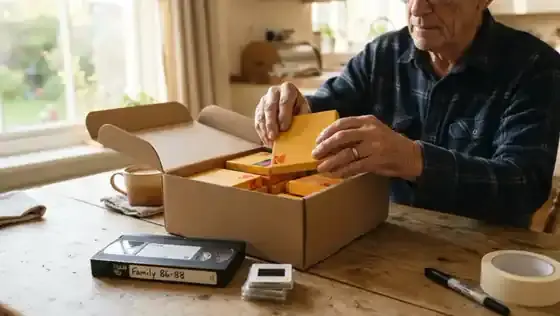
The box itself. The page says each kit comes with a personalized welcome guide, safety barcodes for every item, and a prepaid shipping label.
You stick a barcode on each reel, pack the box, and drop it at any UPS location.
The company says each item is barcoded and "scanned up to a dozen times," and that you get emailed updates along the way.
The wait. The page's own answer is short: standard processing "takes around 4-6 weeks."
You can pay more to go faster, $14.99 for two to three weeks or $19.99 for about one week, at least at the Starter size.
The way back. Return shipping is listed at no charge, and the originals come home with the copies.
That was the line Marlene cared about most, because she was not about to mail away her wedding and get back only a link.
The storage choice. Here is the first piece of small print, and I'll say it plainly: the kit price is not the whole price.
On the order page you pick how you want your copies back: a digital download, a thumb drive, or a set of DVDs.
Each one is an added charge, and at the Starter size those charges were $5.99, $4.99 and $4.99 when I checked.
The membership. The page says every kit includes a 30-day Legacybox Membership trial at no charge, which lets you watch and download your files in their app.
After that, the store sells a family membership plan for $7.99 a month or $79.99 a year.
The site doesn't spell out whether the trial turns into a paid plan on its own, so I'd mark the calendar and decide on day twenty-five.
How Much Wedding Fits on One Little Reel
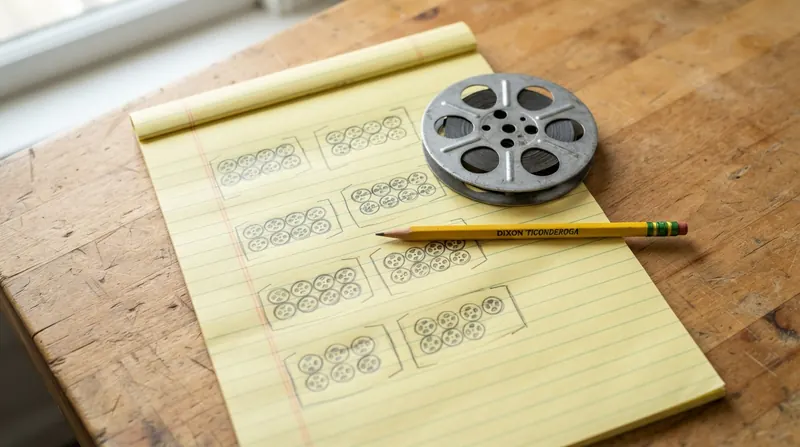
I spent three evenings with a pencil, and Marlene sat in on two because she wanted to see what an estimate looked like from the customer's side of the counter.
Here's what the arithmetic says, and it's the first thing nobody had ever told me about our reels.
Super 8 film runs seventy-two frames to the foot. A standard home-movie cartridge held fifty feet, which is 3,600 frames.
At the eighteen frames a second most home cameras used, that's about three minutes and twenty seconds of picture. At twenty-four frames a second, it's two and a half minutes.
So our eight wedding reels, if Dick shot them the usual way, came to something like twenty-five minutes.
Twenty-five minutes of the most important afternoon of my life, sitting in eight saucers under the stairs.
My mother's three reels came to about ten minutes.
I'd have paid any amount for ten minutes of her, and that's exactly the kind of thinking a man should check with a pencil before he checks out.
That's where the counting rule helps.
Because the company counts by the reel and not by the foot, our short reels cost the same per item as a long one would, and a 50-foot reel and a 400-foot reel are both "one."
If your relatives spliced their little reels onto one big reel, as some careful uncles did, that big reel still counts as one item.
Dick was not that careful, which is why I had thirty-one reels instead of four.
What One Reel Costs at Each Kit Size
Now the money, because Marlene made me promise I'd put it in black and white.
I'm going to give you the regular prices the seller lists, because sale prices come and go and I won't build a column on one.
At the regular price, the Starter kit is $69.98 for two items, or about $35 a reel.
The Family kit is $319.98 for ten, the Closet $639.98 for twenty, the Trunk $1,249.98 for forty and the Vault $2,499.98 for eighty.
Notice the shape of that chart.
The price per reel hardly moves, from about $35 down to about $31, so a bigger box mostly buys you a bigger box, not a much cheaper reel.
And the week I re-read the page in October, everything was marked down 40 percent, the Starter to $41.99.
Sales like that seem to come around on that site, and I'd simply check the page the day you order rather than plan around one.
What I'd tell a customer at the counter: start with the Starter, two items, the two reels that matter most.
You'll see how the box, the wait and the copies come out, and you'll have spent the price of a dinner out instead of a used car.
That's what Arlo told me, and it's what I did.
Six Things This Box Is Not, Written Before Anything Else
Before I tell you what came back in the box, I want to list what this kit is not.
On a repair ticket, the exclusions go above the estimate, so nobody mistakes one for the other.
It is not a health product of any kind. It's a cardboard box and a copying service, and it does nothing for the small things a head drops after seventy.
My clinician keeps track of my head. The box keeps track of the reels, and those are two different jobs.
It is not a promise that every frame comes back perfect.
Old film and old tape are what they are, and the company's own reviews, which I'll show you, include a fair one about grainy spots and sound problems on twenty-year-old tapes.
It is not a forever cloud. The app is a thirty-day trial, and after that it's a paid plan if you want it;
the download, the thumb drive or the discs are what you actually keep.
It is not instant. Standard is four to six weeks, by the company's own words, and that's a long time to have your wedding in Tennessee.
It is not cancellable once the full box leaves your hands.
The company's policy says that once you've sent in your filled box to be processed, the order can't be canceled or returned.
And it is not risk-proof in the mail.
The shipping policy puts the risk of the trip on the customer unless you buy an optional protection package, so read that line before you seal the tape.
I'm printing all six because I'd want someone to print them for me. A box that only lists its strong points is a box I'd send back unopened.
Saw you carrying a big box to the car. Everything all right over there?
9:15Sending the wedding reels to be copied. Two of them, as a test.
9:21Oh Gene, Lou had slides in our basement. Two hundred of them, at least.
9:22Come over when they're back and bring tomatoes. I'll tell you how it went.
9:24
Six Customers, in Their Own Words, Including the Grainy Parts
I'm one man with one box.
So I went looking for what other people had said about the same kit, and I'm going to show you what the seller's review page actually displays, word for word.
When I read it in October, the kit's page showed a 4.8-star rating across all its sizes, from about 8,500 reviews. The spread matters more than the average:
7,121 five-star, 1,269 four-star, 25 three-star, 26 two-star and 38 one-star, in the widget's own count.
Thirty-eight people out of thousands gave it one star, and I couldn't read all of their stories.
I'll show you a four-star review with real complaints in it, because a review page with no bad days is a page I wouldn't trust with a nickel.
The photos next to each review below are illustrative portraits, not the reviewers themselves; the seller's page publishes first names and initials, not faces.
The words are theirs, copied exactly, trimmed only at the end of a full sentence.

I've had these 8mm video cartridges stored away for more than 20 years and finally decided to have them digitized. I went into the process understanding that some of the footage might not be recoverable, so I was amazed at how much was successfully restored. Being able to see my mom again, who passed away years ago, and watch my children when they were little brought back priceless memories.

Got married in 1989, had 2 VHS tapes which landed who knows where through the years. . . . garage, basement etc. Quality not crisp, but so awesome bringing back my wedding to life and seeing my Hubby again and all past relatives.

Legacybox was wonderful with updates on my tape transfers. Shipping was great and in excellent condition. I had tapes from years ago and I'm so thrilled to watch them now.
Read Mario's review twice, because it's the most honest five stars I've ever seen. "I went into the process understanding that some of the footage might not be recoverable."
That's a repairman's sentence, whether he knows it or not. He set his expectations at the bench before he opened the set, and then he was pleasantly surprised.
And notice what Mario and Christine are writing about: a mother who passed away, a wedding, relatives who aren't with us anymore.
Christine's line, "Quality not crisp, but so awesome," is the whole thing in seven words.
I'll hold those reviews the way I'd hold any customer letter. They're real people describing their own orders, in their own words;
they are not a test of the service, and they aren't a promise about your reels or mine.

they supplied a quality box to return my film in. supplied a manual that was personalized to welcome me to their company. It had everything in it to walk you through the procedures. they supplied bar code labels for each one of my films.

I am a first-time user for your work. The initial thought is to try and see what happens with just the conversion of 2 VHS tapes. Throughout the process with your precision guidance and smartly designed user friendly kit, everything went smoothly, and I am impressed by your way of doing business.
Gordon and Paul are talking about the part I can vouch for myself, which is the box and the guide.
Gordon noticed the barcodes, the way a fellow who mails his film anywhere ought to.
Paul did exactly what Arlo told me to do: two tapes first, "to try and see what happens." I'd shake that man's hand.
Now the four-star review. I'm printing it because Arlo would never forgive me if I didn't, and because it's the one that makes the others believable.

Even though the returned DVD's were all copies of the VHS tapes, there were some tracking issues and grainy issues along with sound issues. I understand these issues, as these VHS tapes were probably 15 to 20 years old.
Don's review is a fair man's review. Tracking problems and grain on a twenty-year-old VHS tape are exactly what I'd have predicted at the bench, and he knew it too.
Here is how I read all six together.
The box and the guide get praise, the wait gets updates, and the picture is only ever as good as the film or tape that went in, which every one of them understood.
If you're expecting your 1983 camcorder tape to look like tonight's ball game, Don is your man.
If you're hoping to see your mother walk across a room again, you're probably with Mario.
Six Weeks of Waiting, Good Days and Bad Ones
I sealed the Starter box on a Monday in early May, with two reels in it.
Wedding reel number one, the church and the front steps, and the first of my mother's three.
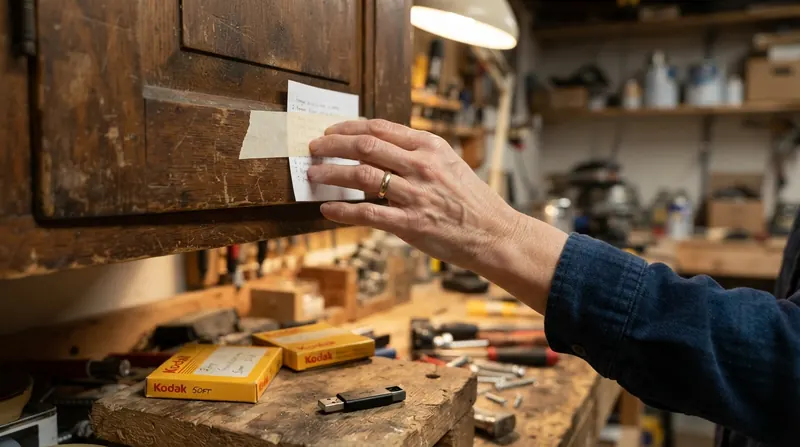
I kept a log, because I keep a log on everything. It's taped inside the cabinet door above my workbench, and here it is.
Gene's log, taped inside the workbench cabinet, May to June
- Day 1Two barcodes on two yellow boxes. Packed with the welcome guide's instructions and a strip of masking tape with "1" and "2" on it. Marlene checked my work twice.
- Day 2Dropped at the UPS store on Alpine Road. The young man at the counter asked what was inside, and I told him, "my wedding."
- Week 1Email: the box arrived in Chattanooga. I read it out loud at supper. Marlene said, "Well, it's in Tennessee now."
- Week 2Nothing. Same basement, same dish towel. Wrote "nothing" six days in a row and nearly called to ask what was taking so long.
- Week 3An update email: the items were checked in and counted. Two items, matching my list. Went back to the Legion on Tuesday.
- Week 4Bought a new bedsheet for the basement wall, and then remembered we have a television. Kristin laughed at me for ten minutes on the phone.
- Week 5Email: the order was finished and on its way home. Read it twice, and took the dish towel off the old projector out of habit.
- Week 6The box came back on a Thursday, the two yellow boxes inside, and a thumb drive in a little envelope.
I want to slow down on week two, because it's the week most people would pick up the phone.
Six lines in a row that say "nothing," in the handwriting of a man who suspected his wedding was sitting on a loading dock.
What kept me patient was the same thing that kept me patient at the bench. You don't judge a repair by its second week; parts take the time parts take.
Week three is the line I'd circle if I were grading this. "Two items, matching my list."
That email was why I'd numbered everything with masking tape in the first place. The box had arrived, somebody had counted it, and the count matched mine.
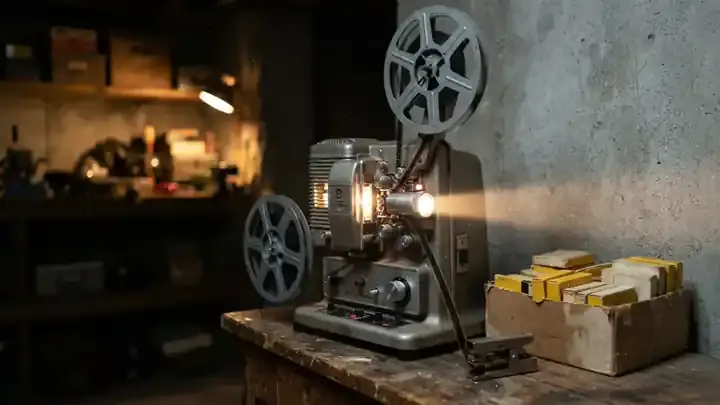
Week four is the one Marlene asked to see in the log, because it's the silliest.
I'd bought a brand-new bedsheet for the basement wall before it occurred to me that a thumb drive plugs into the television in the living room.
Thirty-one years of repairing televisions, and I'd forgotten I owned one. Kristin still calls that week "the bedsheet incident."
Week six is the box coming home.
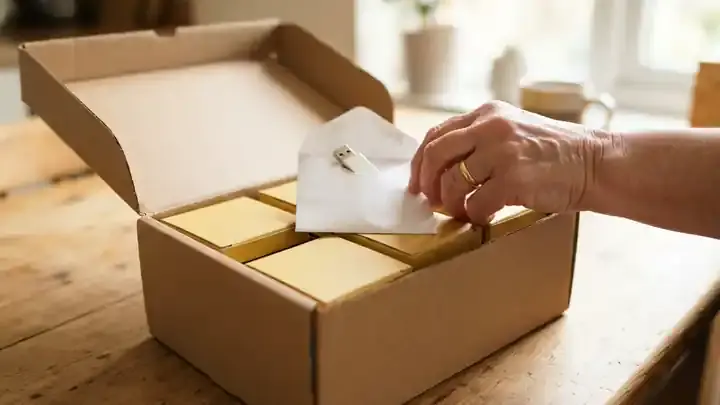
It came on a Thursday, the same plain box, with my two yellow boxes inside exactly as I'd packed them, and a thumb drive in a small envelope.
I didn't open the envelope until Marlene got home from the library. Some things a man doesn't do alone after forty-eight years.
What We Saw on a Thursday Night in June
On a Thursday night in June, a week before our forty-eighth anniversary, Marlene and I sat on the couch with the thumb drive in the side of the television and the lights off.
I'd like to tell you it looked like a movie. It looked like 1978, which is better.
The colors were warm in the way Super 8 is always warm.
The picture jumped a little when Dick's hand jumped, and there was a long stretch of the church ceiling where he'd clearly forgotten the camera was running.
And then there were the front steps.
Marlene in her mother's dress, me in a rented tan suit with lapels you could land a plane on, and both of us squinting into the June sun.

There's no sound on Super 8 of that kind.
So when the reel got to the reception, and the two of us were dancing in the church basement under the paper bells, Marlene hummed.
She hummed it all the way through. It was "You Light Up My Life," and I'd have bet you a hundred dollars it was something else, and I'd have lost.
I didn't need the song back from my own head.
It was in Marlene's, and it was on the screen, and that's two places better than the one I'd been searching all spring.
Then the second reel. My mother, in 1979, in our first backyard on Ashland Avenue, carrying a plate of deviled eggs from the back door to the picnic table.
She swung her left arm and not her right, because the right was holding the plate.
She walked fast, the way she did everything, and she looked straight into the camera and said something to Dick that I'll never know.
I watched that eleven-second walk seven times. Marlene didn't say a word, and she didn't need to.
That's the most honest sentence I can write about the box: it didn't give me anything back from my head; it gave me back what was on the reels.
The head is my clinician's department, and it's doing about as well as a head does at seventy-two.
Marlene wrote that the next morning and taped it where I'd see it with my coffee.
Marlene counts everything, including the number of times I said "I've got it" when I didn't, which was eleven in April.
And notice the order she put it in: the rest of the reels, then Dolores. The box rides along; the people drive.
The Second Box, and What We Did With the Files
In July we ordered a Family kit, ten items, and sent the other seven wedding reels, my mother's last two and the Lake Geneva reel with the chewed leader.
Ten items, ten barcodes, ten strips of masking tape.
That box took about five weeks too.
Everything on my list came back, and the Lake Geneva reel turned out to have nothing wrong with it past the eighteen inches of white leader I'd already ruined myself.
We chose the digital download for the second box and the thumb drive again, because Kristin wanted the files on her computer in Madison and Marlene wanted something she could hold.
The thirty-day trial on the app came and went, and I put a note on the calendar for day twenty-five, the way I said I would.
We decided we didn't need a monthly plan, because the files were already on the thumb drive and on Kristin's computer.
That's a decision every family should make for itself. I'd only ask you to make it on purpose, with a calendar, instead of by accident with a card statement.
Dad, your SUIT. Who let you out of the house in that suit?
9:48Your grandmother. She also picked the lapels.
9:50Grandma's walk in the backyard: I've never seen her move before. I'm crying into the dishes.
9:52So did I, seven times. Your mother counted.
9:55Where the Reels Actually Fit in a Week
People ask what life looks like now, as if there were some grand new routine. There isn't, and that's the point.
7:00 a.m. Coffee with Marlene at the kitchen table, which is not negotiable and never will be.
Then her list for the store, which I now read out loud twice before I leave the house, and which has worked better than anything else I've tried for the list I forget at the store.
9:30 a.m. Tuesday coffee at the Legion with Arlo, Frank and Walt.
I don't always find every name on the first try. Nobody at that table does, and it turns out we all stopped pretending at about the same time.

Sunday, 4:00 p.m. Kristin calls from Madison, and once a month we all watch the same reel at the same time, her on her computer and us on the television.
Last month it was Lake Geneva, 1984: Kristin at five, refusing to get into the water, then refusing to get out of it.
Most evenings. Nothing to do with reels at all: supper, the news, and Marlene doing the crossword out loud so I can fail to find the seven-letter words in good company.
That's why I trust it, honestly. A box that asks for one afternoon of packing and six weeks of patience is a thing you'll actually finish.
The used projector asked for my best screwdrivers and ate a leader. The gadget asked for my whole weekend and flickered;
the box asked for masking tape and a trip to the UPS store, and the wedding is on our television.
How to Sort a Basement Box Like a Repairman
Before any box gets ordered, there's the sorting, and more readers have asked me about that than about the kit.
So here's the method, exactly as I did it, and it works whether you send anything away or not.
Bring everything up out of the basement first. Film and tape don't love damp concrete or a furnace room, and you can't sort what you can't see under a bare bulb.
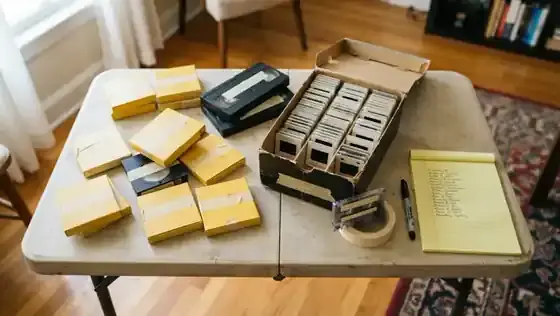
One card table, one roll of masking tape, one marker. Every reel, tape and shoebox gets a strip of tape with a number on it before you do anything else.
Write a list with the number first. Then what's on the label, then what you think is really on it, because those are often two different things.
Our "Christmas 1981" reel turned out to be half Christmas and half a fishing trip on the Rock River. Dick never wasted the end of a cartridge.
Smell before you thread. Arlo taught me this one:
if a reel smells sharply of vinegar, set it aside and mention it, because film in that condition needs gentler handling than a home projector gives it.
Don't run anything through an old machine to "check." That's the rule I broke, and it cost me eighteen inches of white leader that, thank heaven, had nothing on it.
Pick the ten that matter most. You will not send everything at once, and you shouldn't; start with the reels you'd carry out of a burning house.
Ask the family before you choose. Kristin wanted the wedding; Marlene wanted my mother; I wanted the Lake Geneva trip, and we all three were right.
Keep the list. When the box comes back, the list is how you'll know everything you sent came home.
That last rule is the one I'd keep even if I'd never heard of a kit.
A numbered list on a card table turns a basement of "someday" into a job with a beginning and an end.
Ten Letters That Came to the Workbench
After the short column ran in the summer, I got more letters than I've had since I closed the shop. I've answered the ones that asked what most of the others asked.
The letters below are illustrative composites, retold from reader notes with names shortened. The answers are mine, the same ones I'd give across the counter.
Short answers to the questions Arlo gets at the Legion
What counts as one item?
The seller's page says "1 item = 1 reel, 1 tape, or 1 pack of 25 photos," and you can mix them in one box. Film is counted by the reel, not by the foot.
Will they take 8mm and Super 8 film?
Yes, the pricing page lists 16mm, 8mm, Super 8 and Regular 8 film. It also lists VHS, Betamax, camcorder tapes, slides, negatives, prints and audio cassettes.
How long does it take?
The page says standard processing takes around 4 to 6 weeks. Faster options cost extra: $14.99 for about two to three weeks or $19.99 for about one week, at the Starter size.
Is the kit price the whole price?
No. You also choose a digital download, a thumb drive or a disc set, and each one adds a charge; at the Starter size those were $5.99, $4.99 and $4.99 when I checked.
Do I get my originals back?
Yes. The seller says return shipping comes at no charge and your originals come back with the digital copies.
What about the app?
Every kit includes a 30-day membership trial for the app. After that, the store sells a family plan for $7.99 a month or $79.99 a year; decide before the trial ends.
What if I send more items than my kit covers?
The seller says it will invoice you for the extra items once your order is checked in. I'd count twice and keep a list.
What if something comes back wrong?
Contact them for a review within 30 days of the order being completed. The policy says that if they can't fix it, you get your money back.
Can I cancel after I mail the box?
The policy says a filled box already sent in for processing can't be canceled or returned. Decide before you seal the tape.
How do I reach them?
AMB Media, LLC dba Legacybox, Chattanooga, Tennessee. Phone (423) 375-0000, weekdays 9 to 5 Eastern; email questions@legacybox.com.
What Readers Wrote When This Ran as a Short Column
A shorter version of this column ran in the summer. The comments were better than the column, which is usually how it goes.
The comments below are illustrative, retold from reader notes with names shortened. Replies sit indented under the comment they answer, and they're here because they ask what you're probably asking.
Norma's comment is the one I've thought about most. "Told everyone it was my hip."
I did the same thing with the Legion. We invent a respectable reason, because the real one feels like a confession, and a confession at our age feels like a verdict.
And Joyce's comment is the reason I'd print the money section again tomorrow.
Whatever box you send away, read the order page slowly and add up what you check before you check out.
Arlo and I, Recorded for the Post Newsletter
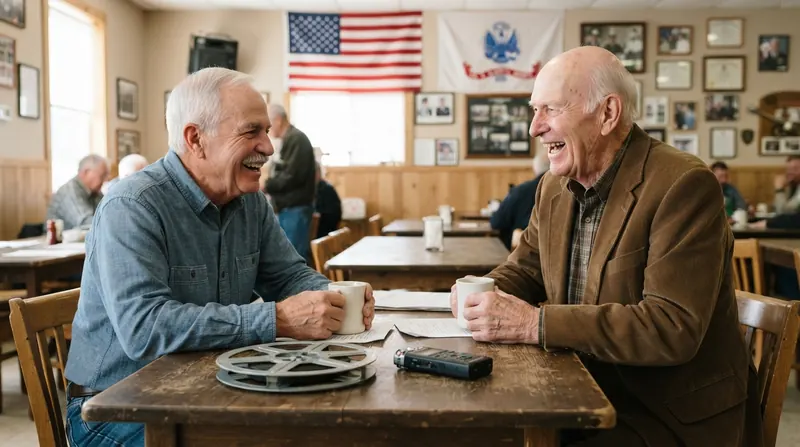
In August, the Legion post newsletter asked whether Arlo and I would let them record one of our Tuesday conversations for the "Members" page. Arlo said yes before I could say no.
Here's the transcript, trimmed only for the parts where Walt interrupted to ask about the Cubs.
Members · The Tuesday Tapes, Episode 3
Two Old Hands, Thirty-One Reels and One Cardboard Box
Gene
host
Arlo, the newsletter wants to know why a shop teacher walked two houses down and told me to stop repairing my own projector.
 Arlo
guest
Because you'd stopped coming on Tuesdays, and you're the only man at this table who can find a fuse in the dark. I needed you back for purely selfish reasons.
Gene
host
And the welcome guide? You could have brought a casserole.
Arlo
guest
A casserole is for after something's lost, and a work order is for before. Your film was fine, Gene; the only danger in that basement was a handy man with a tired machine.
Gene
host
I read the whole page, you know, every line. The storage choice costs extra, the app is a thirty-day trial, and once the full box leaves your hands, you can't call it back.
Arlo
guest
I never told you it was perfect; I told you it counts by the reel, it puts a barcode on everything, and it sends the originals home. You're the one who went looking for the small print.
Gene
host
Fair enough, so tell the newsletter the honest version. What does it do?
Arlo
guest
It turns a reel you can't play into a file you can, and the picture is only as good as the film: Super 8 from 1978 looks like Super 8 from 1978. But your mother walked across that yard on your television, and nobody's screwdriver did that.
Gene
host
And what would you tell somebody standing at the bottom of their own basement stairs right now, with a flashlight and a box?
Arlo
guest
Bring the box upstairs, number everything, and don't thread a single reel. Pick the two that matter most and send those first, then decide about the rest when you've seen them.
Arlo listened to the recording afterward and asked for one correction. He wanted it on the record that he has never once ruined a reel of film, which Frank disputes.
I've gone back to that last line of his more than any other. "Pick the two that matter most and send those first."
2-item Starter kit · storage choice added at checkout · read the terms below before ordering
The Return and Refund Terms, Read Like a Contract
Now the part most columns skip, and the part I'd have read first at the shop: what happens if something goes wrong.
I want to be very plain here, because this is where a lot of mail-order companies get slippery.
This seller does not offer a no-questions satisfaction promise, and I'm not going to call it one.
What it offers is a review policy, and the policy has conditions in it.
I read it twice, the way I'd read a parts warranty, and here it is in my own words.
If you think they missed something on your finished order: you contact them to set up a review. In the company's words, "if we can't fix them, you get your money back."
The window: the policy says it accepts returns within 30 days of the order being completed. Mark the date the box comes home, because the clock is already running.
Before you send your box: if the kit hasn't shipped to you yet, the policy describes a full refund.
If it has shipped, it describes a refund less shipping and a restocking fee, within 30 days of the original order date.
After you send your box: this is the line I'd underline twice. Once you've sent in your filled box to be processed, the policy says the order can't be canceled or returned.
Items they can't copy: the terms say they'll refund the transfer price for anything they can't digitize, and return the original if possible.
Here is what I'd actually do, as a man who spent thirty-one years telling customers to replace the cheap part first.
Start with the Starter, two items, the two reels that matter most.
Two reels is enough to find out whether you're a Mario or a Don. If you're a Don, you've learned it on two reels instead of forty.
The company is AMB Media, LLC, doing business as Legacybox, and it lists a street address on Cumberland Street in Chattanooga.
It also publishes a phone line, (423) 375-0000, staffed Monday through Friday, nine to five Eastern, and an email address, questions@legacybox.com.
A street address, a phone number and a policy with real conditions in it.
My checklist for any parts supplier at the shop was three lines long, and this box ticked all three before I got to the reels.
Shipping, for the record: the kit comes with a prepaid UPS label, and return shipping is listed at no charge.
I'd confirm your address can be served before ordering if you live outside the lower forty-eight.
Who This Box Is For, and Who Should Skip It
I wouldn't close a repair ticket without a recommendation, so here's mine. Fair notice: half of it tells some of you not to buy.
It probably makes sense to look at it if:
- You have film reels, tapes or slides you can no longer play, and nobody in the house has a working machine
- You're handy and tempted to thread old film through an old projector, which is exactly when to stop
- You'd rather send two reels as a test than commit forty at once
- You want the originals back in your hands, not just a link
- Your family is spread out and you'd like everybody watching the same reel on the same Sunday
It probably isn't for you if:
- You need it back next week and don't want to pay for a faster option
- You expect 1978 film or a 1990 camcorder tape to look like a new television picture
- You don't want to choose and pay for a storage option on top of the kit
- You aren't comfortable mailing originals across the country with the transit risk on you
- You want a monthly app forever without deciding about it on purpose
That second line on the second list matters most. This is a copying service, not a time machine; the picture comes back as good as the film that went in.
Where the Box Stands, Line by Line
Here's the summary I'd staple to the front of the ticket. If you only remember one part of this column, make it this one.
✓ Counted plainly: one item is one reel, one tape or 25 photos, and film is counted by the reel, not the foot.
✓ Barcodes on every item and emailed updates, with the originals coming back along with the copies.
✓ A Starter size of two items for finding out how your own film comes back, with a phone line and street address in Tennessee.
✓ A review page that shows its bad days, with a 4.8 average and fair complaints about grainy old tapes sitting right alongside the praise.
✗ The kit price isn't the whole price. The storage choice adds a charge, and faster processing adds more.
✗ Four to six weeks is the standard wait, by the company's own words.
✗ No calling it back. Once the filled box is sent in, the order can't be canceled or returned, and the trip's risk is on you without the optional protection.
✗ The app is a trial, thirty days, and then a paid plan if you want one.
If You're Standing at the Bottom of Your Own Basement Stairs
I can't tell you what to do.
I can tell you what I'd do if I were reading this column instead of writing it, back in April, with a flashlight in my hand.
First, before you buy anything at all: bring the boxes upstairs. Damp concrete and a furnace room are no place for film or tape.
Second: number everything with masking tape and make a list. Write what the label says and what you think is really on it.
Third: call the family. Ask what they'd most want to see, and you may be surprised; Kristin had never once seen our wedding.
And fourth, if a reel or a tape you can't play is still the thing on your mind: read the kit page I've been describing for ten thousand words.
Two items, one reel each, a storage choice, about four to six weeks.
I won't pretend a link at the bottom of a neighborhood column is anything but a door to the seller's shop. Reel Box Memories doesn't keep inventory; we keep lists.
But if you walk through that door, you'll know exactly what's on the other side:
a cardboard box, a barcode for every reel, a policy with real conditions in it, and a phone line in Tennessee.
Two reels to start · storage choice added at checkout · originals come home
One more thing, and then I'll let you get to your own basement. The masking-tape list is still taped inside the cabinet door above my workbench.
The last line reads: "Oct 24. Reel 31 home.
Watched Lake Geneva with Kristin on the phone. Legion Tuesday, my turn to bring the doughnuts."
Reel 31 home. Three words, in marker, written by a man who once skipped four Tuesdays to avoid fumbling a name.
P.S. Arlo's note is taped inside the cabinet door now, next to Marlene's, the ink on both of them fading the way old ink does, and if you have an Arlo in your life, thank him; if you are the Arlo, walk over anyway.
P.P.S. Remember what Arlo said on the tape: pick the two that matter most and send those first; the box is the smallest part of this story, and it's the only part that comes in the mail.
The full guide to what's in the box, what it costs and how to read the advertising around it is linked at the foot of this page.
First, the people: Gene Halvorsen is a pen name. Marlene, Arlo, our daughter Kristin and the house on Ashland Avenue are composites, the way neighborhood columns have always been written.
Everything about the kit itself, its price, its box, its shipping, its wait and its terms, comes from the seller's own pages, read in October 2026.